The National Trust cares for some of Northumberland's most remarkable places, from grand Victorian country houses to rugged coastal castles and ancient woodland. Whether you are a member or paying on the day, these properties make for outstanding days out across the county.
Cragside
The house that lit the world
Cragside (55.3156, -1.8976) near Rothbury was the home of Victorian inventor and arms magnate Lord Armstrong. In 1878 it became the first house in the world to be lit by hydroelectric power. The house itself is a dramatic jumble of Tudor-revival gables, towers, and chimneys perched on a rocky hillside above the Debdon Burn.
The estate covers over 1,000 acres with miles of walking trails through one of the largest rock gardens in Europe, past lakes, and through the Iron Bridge gorge. The formal gardens include a stunning Italianate terrace. Allow at least half a day to do it justice.
Address: Rothbury, Morpeth, NE65 7PX
Wallington
A family house with a walled garden to rival any
Wallington (55.1544, -1.9463) is a grand but homely country house near the village of Cambo. The interior has painted rooms, porcelain, a cabinet of curiosities, and the magnificent Central Hall painted by Pre-Raphaelite artist William Bell Scott. The walled garden is one of the finest in the north of England, with herbaceous borders, a greenhouse, and a productive kitchen garden.
Outside, the parkland is free to walk year-round and includes a woodland adventure playground. The clock tower houses a secondhand bookshop. A proper all-weather destination.
Address: Cambo, Morpeth, NE61 4AR
Lindisfarne Castle
A fairytale on Holy Island
Perched on a craggy mound of volcanic rock, Lindisfarne Castle (55.6687, -1.7842) was converted from a Tudor fort into an Edwardian holiday home by architect Edwin Lutyens in 1903. The small walled garden, designed by Gertrude Jekyll, is a short walk away.
Important: Holy Island is tidal. You can only reach it by car across a causeway at low tide. Check the tide tables before setting out, as drivers are regularly stranded. Allow time on the island to also visit the Priory ruins (managed by English Heritage, separate admission).
Address: Holy Island, Berwick-upon-Tweed, TD15 2SH
Allen Banks & Staward Gorge
The largest area of ancient woodland in Northumberland
Allen Banks (54.9472, -2.2843) is a deeply atmospheric gorge cut by the River Allen near Bardon Mill. The 200 acres of ancient semi-natural woodland include a network of well-maintained footpaths, a Victorian suspension bridge, and the medieval ruins of Staward Peel tower.
Entry and parking are free for National Trust members; non-members pay a small parking charge. Dogs are welcome on leads. The walks are hilly in places, so wear sturdy shoes.
Address: Bardon Mill, Hexham, NE47 7BP
Cherryburn
Birthplace of Thomas Bewick
This modest cottage (54.9581, -1.8842) in the Tyne Valley was the birthplace of Thomas Bewick, widely regarded as the father of modern wood engraving. The farmstead has been preserved as a small museum with demonstrations of the printmaking techniques Bewick pioneered. A quiet, contemplative visit best combined with a walk along the nearby Tyne.
Address: Station Bank, Mickley, Stocksfield, NE43 7DD
Seaton Delaval Hall
Vanbrugh's theatrical masterpiece
Seaton Delaval Hall (55.0729, -1.5252) is one of the most important baroque buildings in the north of England, designed by Sir John Vanbrugh in 1718 for Admiral George Delaval. The central block was gutted by fire in 1822 and remained a dramatic shell for nearly 200 years before the Trust acquired it in 2009.
Ongoing restoration means parts of the house are periodically closed, but the wings, gardens, and grounds are well worth exploring. Check the website for current opening before visiting.
Address: The Avenue, Seaton Sluice, NE26 4QR
Dunstanburgh Castle
National Trust owned, managed by English Heritage
The gaunt ruins of Dunstanburgh Castle (55.4897, -1.5940) occupy a dramatic basalt headland above the North Sea. Built by Earl Thomas of Lancaster in 1313, it is reached only on foot along a mile-and-a-half clifftop path from Craster, making the approach one of the great coastal walks in England.
Admission is charged by English Heritage (free for EH members). National Trust members enter free to the surrounding headland but need an EH ticket for the castle interior.
Address: Embleton, Alnwick, NE66 3TW
Housesteads Roman Fort (Hadrian's Wall)
National Trust owned, managed by English Heritage
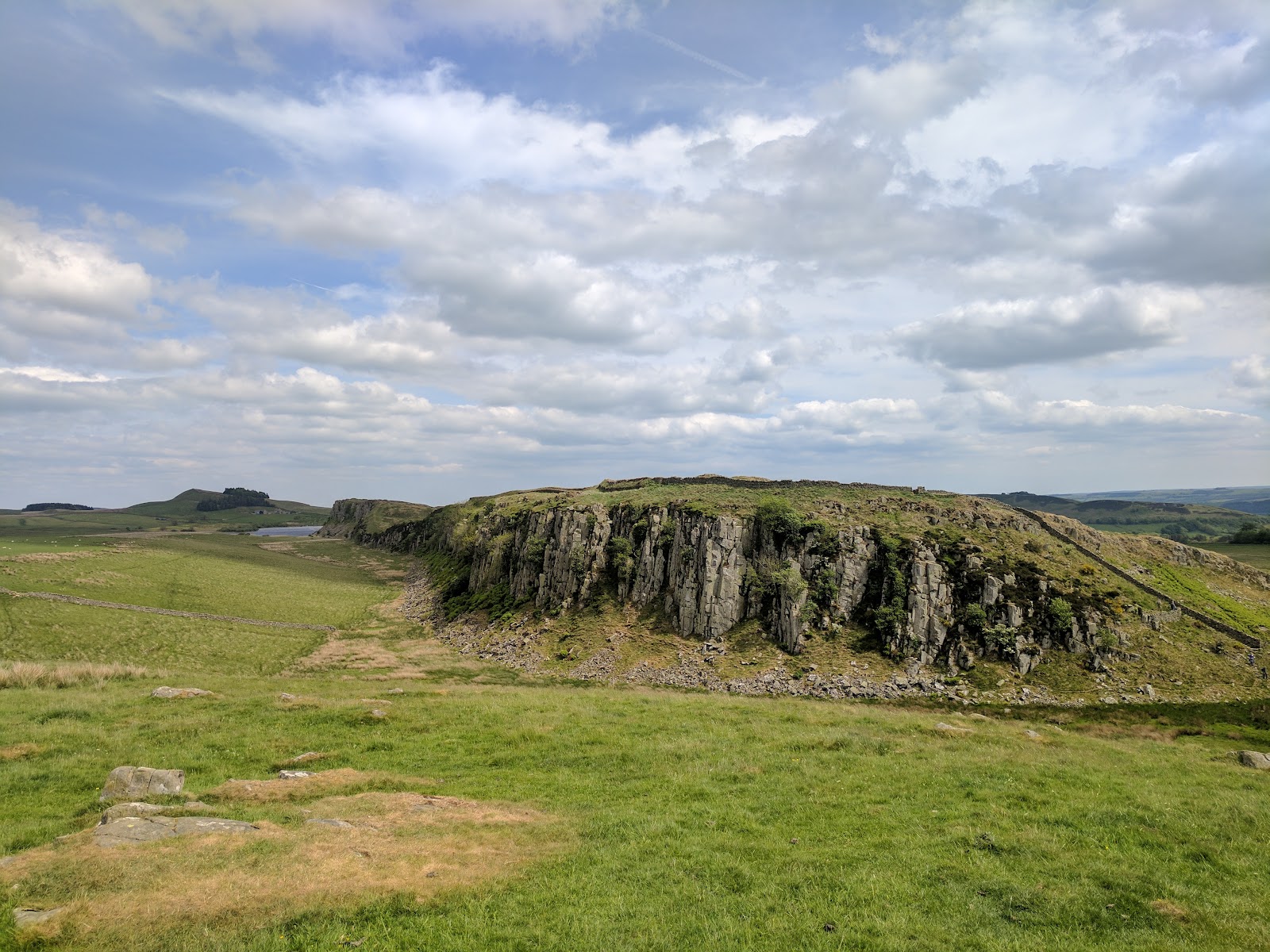
Housesteads (55.0107, -2.3278) is the most complete Roman fort on Hadrian's Wall and a UNESCO World Heritage Site. The visible remains include the commandant's house, granaries, barracks, and the famously well-preserved communal latrines. From the fort, you can walk along the Wall in either direction across some of the most dramatic landscape in northern England.
The surrounding farmland is National Trust and free to walk. Entry to the fort itself requires an English Heritage ticket.
Address: Haydon Bridge, Hexham, NE47 6NN
Farne Islands
Puffins, seals, and seabird colonies
The Farne Islands (55.6308, -1.6537) are a group of rocky islands off the coast at Seahouses, home to one of the most spectacular seabird colonies in England. Between April and late July, you can see puffins, Arctic terns, guillemots, and razorbills at close quarters. Grey seals haul out on the rocks year-round.
Boat trips run from Seahouses harbour (the Trust does not operate the boats). Landing on Staple Island and Inner Farne requires a National Trust landing fee on top of the boat fare. NT members land free. Book well ahead in puffin season.
Address: Seahouses, NE68 7SR
Practical Tips
- Membership pays for itself quickly in Northumberland. Cragside alone costs around £20 per adult; a year's membership is about £80 and covers all NT properties nationwide.
- Dual-managed properties: Dunstanburgh and Housesteads are NT-owned but English Heritage-managed. You will need EH membership or pay EH admission for these, though the surrounding NT land is free to walk.
- Dogs are generally welcome in gardens and parkland on leads, but not inside houses.
- Holy Island tide times are non-negotiable. Do not attempt the causeway outside safe crossing times.
- Most properties are closed or have reduced hours November to February. Check opening times on the National Trust website before visiting.